
Order of the Sinking Star Map and Areas Guide
Start with the Overworld
The Overworld is the central navigation space. The official exploration overview describes four paths branching from the starting point, each leading into a world with its own characters, hazards, mechanics, and secrets. It also presents the structure as non-linear: when one route becomes difficult, you can return to the hub and investigate another path instead of waiting for a single required order. Read the official four-path overview.
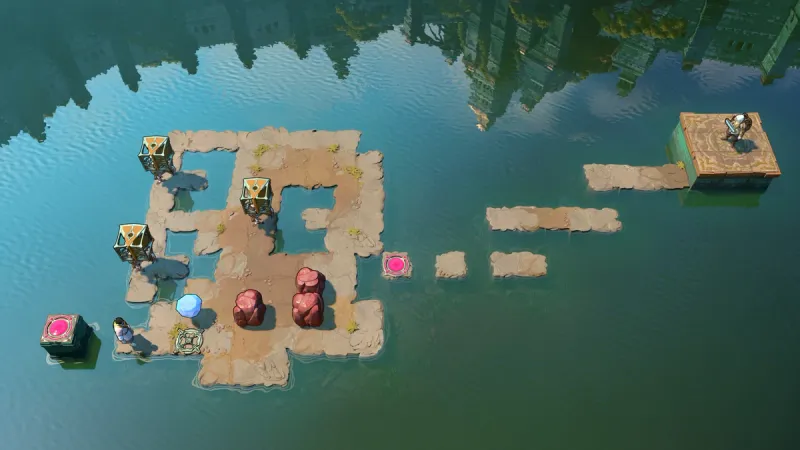
Use this direction table as your first orientation check:
| Direction | Current world name | What to expect first |
|---|---|---|
| North | Heroes of Hauling | A party of heroes whose abilities manipulate objects in different ways. |
| East | Mirror Isles | Islands where magic mirrors swap the player or objects with reflections. |
| West | Vault of the Beamcasters | Caverns built around colored beams, gems, and traversal abilities. |
| South | Skipping Stones to Lonely Homes | Water crossings that depend on stones, lily pads, and route planning. |
The western route has a naming change to keep in mind. Earlier official material called it The Promise; the official Steam launch communication says the western world was renamed Vault of the Beamcasters. If an older video, screenshot, or note says “The Promise,” read it as the historical name for the same west-side route. Check the current official Steam posts.
Read the two map scales in the right order
Start with the overall map when the question is “which world or branch should I visit?” It helps you identify the next large destination, the direction of a route, and which areas remain hidden behind fog. The official overview says that progressing through the Overworld reveals larger areas and more interwoven mechanics as the fog fades.
Open the local map when the question changes to “where is the next platform, exit, or nearby connection?” The supplied Skipping Stones design-study video demonstrates this practical distinction: one map view gives the wider route, while another view gives local room detail. Treat the video as a playthrough demonstration of map use. It does not establish a complete developer-authored coordinate system. Watch the supplied map demonstration.
A reliable map-reading loop is:
- Open the overall view and identify the world or branch you are trying to reach.
- Enter the local view and mark the immediate objective: an exit, a fast-travel point, a blocked connection, or a room you can revisit.
- Compare the visible path with the mechanic currently available to the character or group.
- Leave a route alone when its next step depends on a mechanic you have not learned yet. Record the landmark and return after exploring another branch.
This keeps a map from becoming a list of coordinates detached from the puzzle rules. In this game, a visible route can still be functionally closed until the correct character ability, beam interaction, reflection, or water connection is available.
Activate fast travel as soon as you find it
When you reach a fast-travel point, interact with it before moving deeper into an unfamiliar branch. The provided gameplay material shows the practical reason: fast travel turns a solved landmark into a return point, which matters when later world combinations make an earlier route relevant again. The official game structure also encourages revisiting worlds and challenges at your own pace. Open the official-channel VOD.
Use fast travel after you have identified three things:
- the world or branch name;
- the nearest recognizable landmark;
- the map objective that brought you there.
Write those three labels down in your own notes if the route is large. A note such as “east, first mirror island, blocked upper exit” is more useful than an unverified grid coordinate because it survives small map or language changes.
What a complete map can and cannot tell you
The official sources establish the four-world structure, the Overworld paths, fog expansion, and the ability to revisit routes. They do not provide a complete public coordinate atlas for every room, height layer, connection, and crossover area. The screenshots and supplied videos are useful for recognizing landmarks, while an exact move route still depends on the named room and the game version.
For that reason, use an external map or a player-made coordinate list as a navigation aid only after matching its landmark to your current game. If the grid, fog edge, or room name does not match, switch back to the in-game overall/local map and record the visible landmark instead. The safest next step for an unresolved location is to capture the room name and map view, then search for that exact room rather than searching for a broad world name.
For mechanic-specific help, continue to the hero, mirror, and light puzzle guide. For a demo-era route, see the demo progression guide. Hardware and handheld questions are covered in the system requirements guide.
Sources
- [1]Explore the Realm — official Overworld and four paths overview — Order of the Sinking Star, 2026-09-23
Official description of the Overworld, cardinal paths, four worlds, and fog revealing more of the map.
- [2]Order of the Sinking Star — official Steam launch and update posts — Order of the Sinking Star on Steam, 2026-10-08
Official Steam post records the western-world rename from The Promise to Vault of the Beamcasters.
- [3]Skipping Stones on Release Day | Order of the Sinking Star Design Study — Noël's Study
Provided YouTube gameplay material demonstrating overall-map and local-map use; it is a player video, not an official map specification.
- [4]Order of the Sinking Star | Steam Next Fest Demo Livestream VOD — Order of the Sinking Star
Official-channel VOD included as a gameplay reference for map and fast-travel context.
Was this helpful?
Thanks for the feedback!