
Order of the Sinking Star Heroes, Mirrors, and Light Puzzles
Quick method: identify the interaction before moving
- Record the room name and the goal interaction.
- Identify whether the board calls for a push, pull, wizard swap, mirror reflection, or beam/gem state.
- Mark the final tile or destination before moving anything.
- Try one move, then check which side of the board the hero and object occupy.
- If the room label, layout, hero, or object differs from the footage, stop and find a matching board.
Start with the ability that changes the board
Identify the final tile or interaction first, then choose the hero or system that can make that interaction possible. The official Steam description frames the game around distinct worlds, unique characters, and mechanics that later combine; the goal is to recognize the active rule before searching for a move string.
| If the obstacle is… | Ask first | Evidence-bound hint |
|---|---|---|
| A crystal or block in a lane | Which hero can push it? | The supplied playthrough describes the strong character pushing multiple crystals (observed example). |
| An object that must be brought toward you | Which character can pull it, and where will the pull end? | The developer Q&A describes a character who cannot push but can pull (Q&A segment). |
| A crystal that blocks the wizard | Can the wizard’s crystal teleport put the crystal on the useful side? | The developer Q&A explains that the wizard teleports with a crystal (wizard segment). |
| A gap between islands | Which mirror copy is the destination? | The demo footage shows Mirror Isles teleporting around and distinguishes the player from a rock as a reflected target (Mirror Isles segment, reflection limit). |
| A distant light or beam endpoint | What must be moved before the last light becomes reachable? | The same footage describes moving a mirror to reach the last light (observed light target). |
Heroes: push, pull, and teleport
Use the heroes in an order that leaves the final actor beside the target interaction. Push a crystal or block only when the destination lane remains useful; use a pull to bring an object into reach; and position the wizard so the forced crystal swap moves the object and the character into the required side of the room.
In the supplied playthrough, the strong hero pushes several crystals at once. The developer Q&A shows a thief who cannot push but can pull, with a pull that can leave the character in a bad position; it also shows the wizard swapping with a nearby crystal and becoming trapped by a poor choice. Treat these as examples from the named footage, not universal room instructions. If an object ends on the wrong side, undo before adding another move.
For a room that combines heroes with water or gems, use the named room and current layout as the boundary. The progressive walkthrough and hints guide explains how to increase help without copying an unlabelled sequence.
Mirrors: read the destination before moving
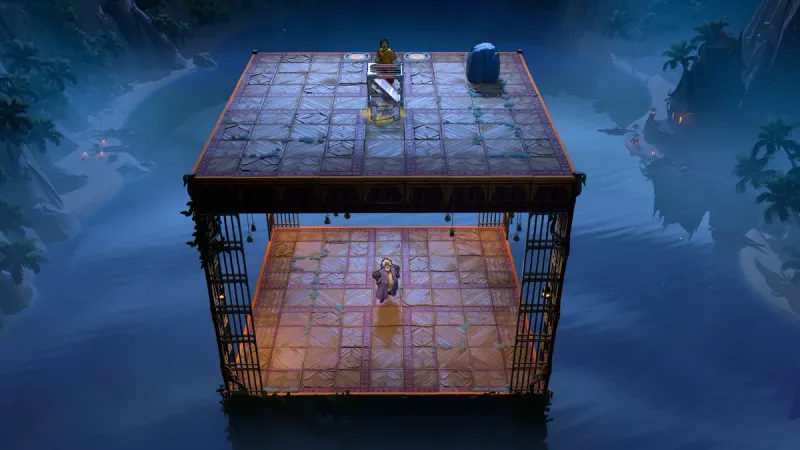
Treat the reflection as an active destination, then move the character or allowed object into the mirror geometry that reaches it. The supplied demo footage shows the player using mirrors to teleport and states that the observed board reflects the player while a rock cannot be reflected; preserve that distinction when planning a move.
- Find the reflection that lands on a useful island or tile.
- Check whether the interaction is with the player, a crystal, or another object; the footage’s rock example does not make every object reflectable.
- Walk into the mirror only after the destination is clear.
- Re-check the new side of the board before moving the next mirror.
These steps describe the observed interaction pattern. They do not give a seven-screen or full-world move list. A mixed Heroes and Mirrors board can reuse the same mirror idea while changing which hero must arrive first.
Light and beam puzzles: solve the endpoint first
Work backward from the light or beam endpoint: identify what must be moved, which beam state opens the path, and which character must occupy the final tile. The Steam description says each world has its own rules and that those systems later intertwine. In one supplied example, a gem goes into a slot, powers a beam, and the beam grants an ability or clears an obstruction. Use that as a sequence to inspect when the room resembles the footage; it is not a universal beam order.
When you are stuck, ask these questions in order:
- Is the endpoint blocked by a mirror position or by a hero position?
- Does changing the beam affect the current room, a connected room, or both?
- Can you undo the last mirror or character move before testing another beam state?
For a beam puzzle, check which endpoint must change, which mirror or character can alter its path, and whether the room itself confirms the new state. The supplied footage shows one mirror-to-light example; use the linked segment only when the room matches, and do not treat it as a universal beam sequence.
For gem or dragon boards, use the dragon and gem puzzle guide. For water crossings, use the skipping-stones guide; its mechanic is separate until a named mixed room joins the systems.
Mixed rooms need a room name
Do not apply a Heroes, Mirrors, or Light move sequence to every crossover board. The store describes worlds colliding and puzzle systems intertwining, while the supplied videos show individual boards. Record the room label, visible characters, and distinctive objects before following a walkthrough. If any of those differ, return to the progressive hint ladder and solve the mechanic at the correct strength.
Before you continue a mixed-room attempt, check three things: the required hero can still reach the final interaction, the crystal or mirror is on the side that enables it, and the beam or reflection actually reaches its target. If one check fails, undo the last move and test a single different ability or object position.
Stone boards: check the crossing before spending a rock
On a Skipping Stones board, first identify the water crossing and the stepping path the room is asking you to make. The Steam description says stones create stepping paths across water. In the supplied Mirror Isles footage, the player also checks whether the remaining rocks can reach the last light (observed segment). Before placing a stone, verify the next landing tile and count what remains for the crossing. If the water layout, stone count, or target differs from the footage, stop and identify the room instead of copying its move order.
What to do when exact moves are unavailable
Use the high-level mechanic, undo the last test, and locate footage whose title and opening layout match the current room. A complete move list is not available for every hero, mirror, beam, or light board. A visible mismatch is the signal to stop and re-identify the room, not permission to guess the next input.
Sources
- [1]Order of the Sinking Star on Steam — Steam, 2026-10-08
Official description of distinct worlds, unique characters, mirror transport, beams, and combined mechanics.
- [2]Jonathan Blow presents the Order of the Sinking Star demo + Q&A — Jonathan Blow highlights
Provided developer Q&A subtitles describe push, pull, character interplay, and wizard teleport behavior.
- [3]The biggest budget sokoban ever made (Order of the Sinking Star demo) — Thinky Games
Provided demo subtitles show Mirror Isles, mirror movement, target light, and reflection limits on observed boards.
- [4]MY NEW MOST ANTICIPATED PUZZLE GAME IS OUT NOW! - Order of the Sinking Star — Aliensrock
Provided playthrough subtitles show distinct character abilities and crystal teleport observations.
Was this helpful?
Thanks for the feedback!